
Given This Day, June 10

I like to imagine that my consciousness, the thing that is conscious, is the eternal soul that I really am, blessed to be born as Bruce de Torres, evolving into that wisdom, to be and feel only eternal love, transcending human fears, worries, angers, and triggers, responding to everyone and everything, giving everyone and everything, only that, eternal love, patience, encouragement, and kindness.
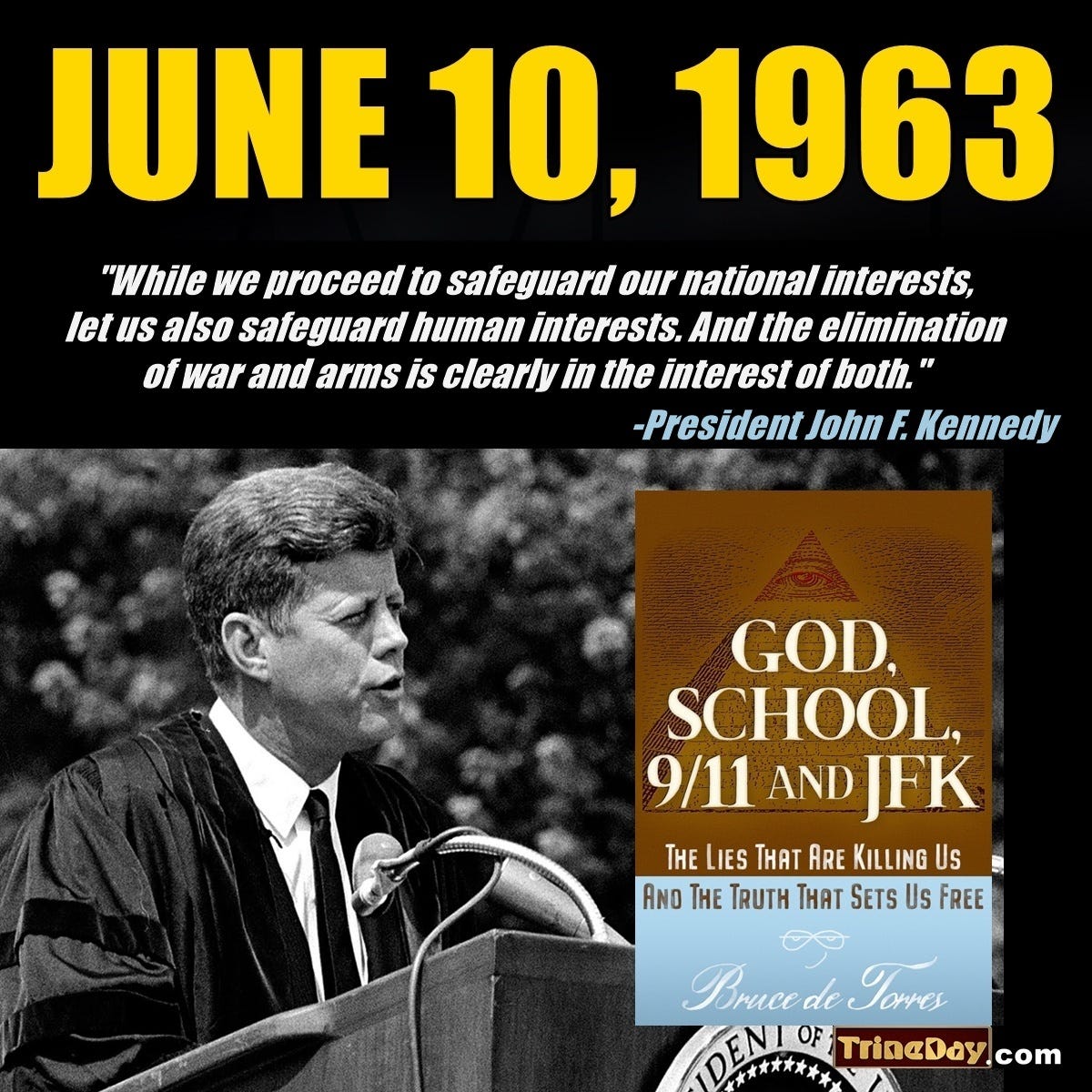
Much of that is in my book, GOD, SCHOOL, 9/11 AND JFK: The Lies That Are Killing Us and The Truth That Sets Us Free.
So is the following about John F. Kennedy’s Peace speech, given this day, June 10, in 1963.
May we all think about (determine) what we want. May we realize that we only have what we give ourselves and others. May we choose to give (have) peace, love, and happiness.
Journalist Norman Cousins told Khrushchev in the spring of 1963 that Kennedy wanted a better relationship with the Soviet Union and was doing all he could to stop raids against Cuba by independent people and CIA-backed exiles. Khrushchev said, Kennedy wants a fresh start? He wants me to forget the past? Okay. I do. But the next move is up to him. Cousins relayed that to Kennedy when he got back to the states.
After hearing what Khrushchev said, Kennedy prepared a speech, without consulting the Joint Chiefs of Staff or the CIA, and delivered it at American University in Washington, D.C. on June 10. In it he belittled the idea that enormous stockpiles of expensive weapons were the only means of assuring peace. He said peace was “the necessary rational end of rational men.… Our problems are man-made, therefore they can be solved by man, and man can be as big as he wants. No problem of human destiny is beyond human beings,” and “our most basic common link is that we all inhabit this small planet. We all breathe the same air. We all cherish our children’s future. And we are all mortal.”
He described how peace – the end of the cold war – could be pursued: by focusing on a gradual evolution in human institutions, through concrete actions and effective agreements in the interest of all. He reviewed “the baseless” Soviet claims that “American imperialist circles are preparing to unleash different types of wars … that there is a very real threat of a preventive war being unleashed by American imperialists against the Soviet Union … [and that] the political aims of the American imperialists are to enslave economically and politically the European and other capitalist countries … to achieve world domination … by aggressive wars.” By denouncing those plans as Soviet propaganda, Kennedy told those American imperialists who had those plans that he stood in their way.
He said our goal since the 1920s had been general and complete disarmament. He revealed that the Soviet Union and the United States would soon meet to negotiate a treaty to ban nuclear testing, and got his first applause. He announced that the United States would stop nuclear testing as long as the Soviet Union stopped, and got his second applause. When he discussed the freedom that was incomplete in many of our cities, and said it is the responsibility of all our citizens to respect the rights of all others and to respect the law of the land, he got his third applause.
Near the end of his speech, he said something never mentioned by mainstream commentary about him: he wanted to eliminate the military-industrial complex. He said, “And is not peace, in the last analysis, basically a matter of human rights – the right to live out our lives without fear of devastation – the right to breathe air as nature provided it – the right of future generations to a healthy existence? While we proceed to safeguard our national interests, let us also safeguard human interests. And the elimination of war and arms is clearly in the interest of both.”
At the end of his speech he said, “The United States, as the world knows, will never start a war. We do not want a war. We do not now expect a war. This generation of Americans has already had enough – more than enough – of war and hate and oppression. We shall be prepared if others wish it. We shall be alert to try to stop it. But we shall also do our part to build a world of peace where the weak are safe and the strong are just. We are not helpless before that task or hopeless of its success. Confident and unafraid, we must labor on – not toward a strategy of annihilation but toward a strategy of peace.”
Disarmament is possible when you’re not at war.
If you make your living from war, disarmament is the enemy.
Kennedy was killed five months after saying “The United States … will never start a war.” Under Johnson, the United States started a big one in Vietnam.
Bruce- thank you for the oh so bittersweet reminder of the high aspirations of JFK.
It has been quite a lifetime. In 1963 I was twelve, and everything changed from there..
Following is a link t my article, "Apocalypse and lifting of veil JFK & 9-11" http://flybynews.wordpress.com/2012/04/18/apocalypse-and-lifting-of-veil-jfk-9-11/